Open Mon-Fri 9am-5pm
1114 Bass Hwy, The Gurdies VIC 3984
Phone +61 (03) 5672 5196
Email info@ecoliv.com.au
Open Mon-Fri 9am-5pm
1114 Bass Hwy, The Gurdies VIC 3984
Phone +61 (03) 5672 5196
Email info@ecoliv.com.au


#Regenerativedesign #Timberconstruction #Carbon
15 April 2026
For years, timber has been framed as the “low-carbon alternative” to concrete and steel.
And while that’s true, it’s also incomplete.
At Ecoliv, we believe timber represents something much bigger. It offers a fundamentally different way of building — one that is faster, more precise, more connected to nature, and ultimately more meaningful for the people who live in our Ecoliv homes.
The shift toward timber isn’t just about reducing emissions. It’s about improving the entire building experience — from how homes are made to how they feel.
There is a reason timber is gaining momentum globally.
The construction sector is under increasing pressure to reduce embodied carbon — the emissions associated with materials and construction. In Australia, this is becoming a defining issue for the built environment.
Timber stands out because it does something no other mainstream structural material can do: it stores carbon.
Trees absorb carbon dioxide as they grow, and that carbon remains locked within the timber for the life of the building. In fact, around 50% of the dry weight of timber is carbon, stored for decades or even centuries when used in construction .
Substituting timber for steel or concrete can avoid between 1 and 2.5 tonnes of CO₂ per cubic metre, depending on the application .
And this isn’t theoretical. Timber products already in use across Australia are estimated to be storing over 97 million tonnes of carbon, with that number growing each year.
But focusing only on carbon risks missing the bigger opportunity.
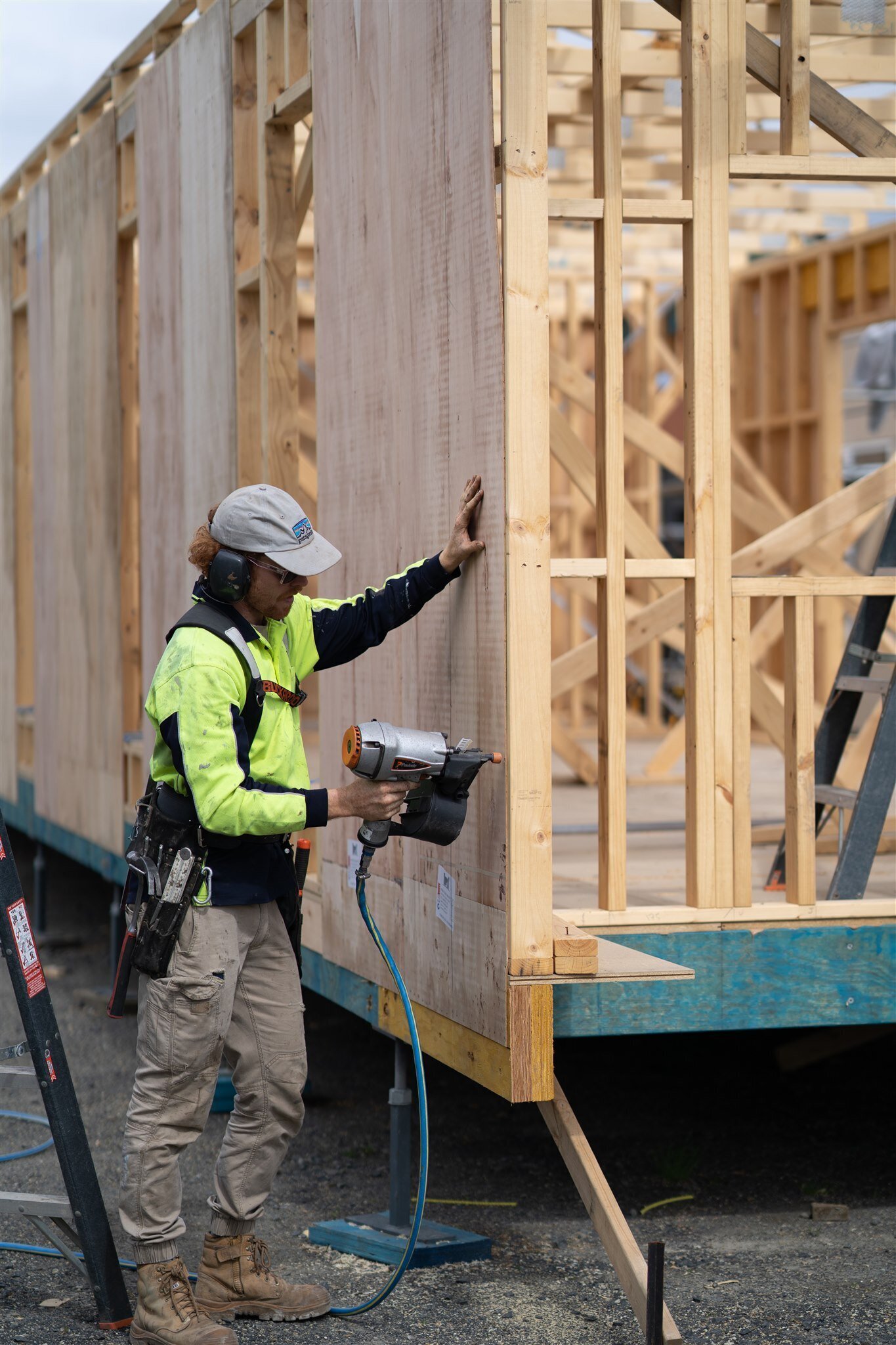
Timber construction — particularly when paired with prefab modular design and construction — enables a level of efficiency that traditional construction methods struggle to match.
At Ecoliv, this is central to how we build.
Timber structures can be designed digitally, constructed in controlled environments with speed and precision. This reduces weather delays, minimises waste, and creates a far more predictable construction process.
The result is not just faster build times, better quality and greater confidence in the project outcome. Clients experience fewer delays. Projects run more smoothly. Outcomes are more consistent.
In an industry often defined by uncertainty, that shift is significant.
The Sandy Point project showcases how timber construction can deliver both high performance and beauty, creating a home that feels warm, durable and deeply connected to its coastal setting. Its timber-built form supports a lighter environmental footprint while bringing richness, texture and a strong sense of place to modular design.
There is also something less tangible — but equally important — about timber.
It changes the experience of a space.
Timber interiors tend to feel warmer, calmer and more grounded. They soften light, absorb sound, and introduce a natural texture that connects people to the environment around them.
For Ecoliv and our customers, this matters deeply.
We are not just designing for performance metrics. We are designing homes that people live in every day. Homes that should feel restorative, not clinical. Comfortable, not industrial.
Timber helps us achieve that.
It allows buildings to sit more gently within the landscape, rather than imposing themselves on it. It supports a regenerative design approach that is quieter, more human, and more connected to place.
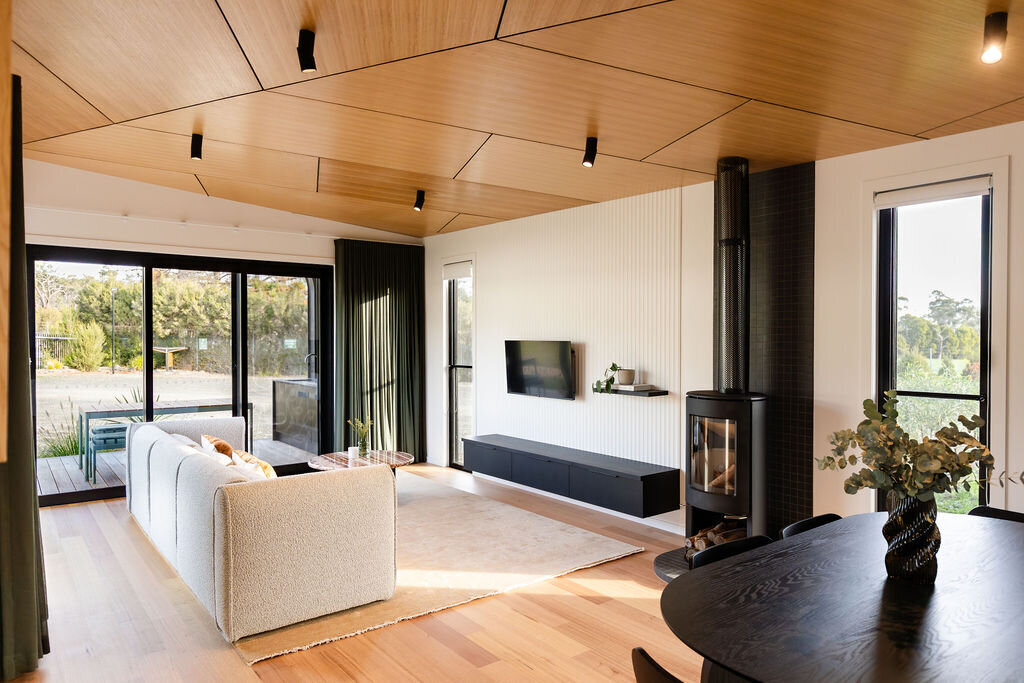
Image: The EcoGeneration 2A display home. The use of engineered Australian hardwood timber ceiling lining and floorboards creates a sense of warmth, grounding the space in natural beauty and inviting you to slow down, breathe deeply, and feel truly at home.
Despite its advantages, timber is still often misunderstood.
There is a lingering perception that it is weaker, less durable, or more vulnerable than concrete and steel. In reality, modern engineered timber tells a very different story.
Laminated Veneer Lumber (LVL) is a high-performance engineered timber made by bonding thin layers of wood veneer together under heat and pressure, resulting in a material that is stronger, more consistent, and less prone to warping than traditional solid timber.
At Ecoliv, LVLs are a key structural component in our modular homes, enabling longer spans, enhanced structural integrity, and precision in our off-site manufacturing process. This supports faster build times, improved quality control, and reduced material waste. We proudly source LVL products from trusted suppliers like Westbeam - helping us deliver durable, high-performing homes aligned with our commitment to regenerative building practices.
Durability, too, is not a limitation of timber itself, but of how it is used. Like any material, timber requires good design, detailing and construction practices. When done well, it can perform for generations.
The question is not whether timber works. It’s whether we are ready to use it properly.
There are clear scenarios where timber is not just a viable option, but the better one.
In prefabricated and modular construction — the core of Ecoliv’s approach — timber offers unmatched efficiency. Its workability, lighter weight, and compatibility with off-site manufacturing make it ideal for precision-built homes.
In regional and remote areas, timber reduces site impact and allows for faster installation and less intensive foundations, which can be critical in these contexts.
And in projects where connection to landscape and wellbeing are priorities, timber delivers a quality of space that is difficult to achieve with heavier, more industrial materials.
Concrete and steel will always have a role. But the assumption that they are the default — and timber the alternative — is increasingly outdated.
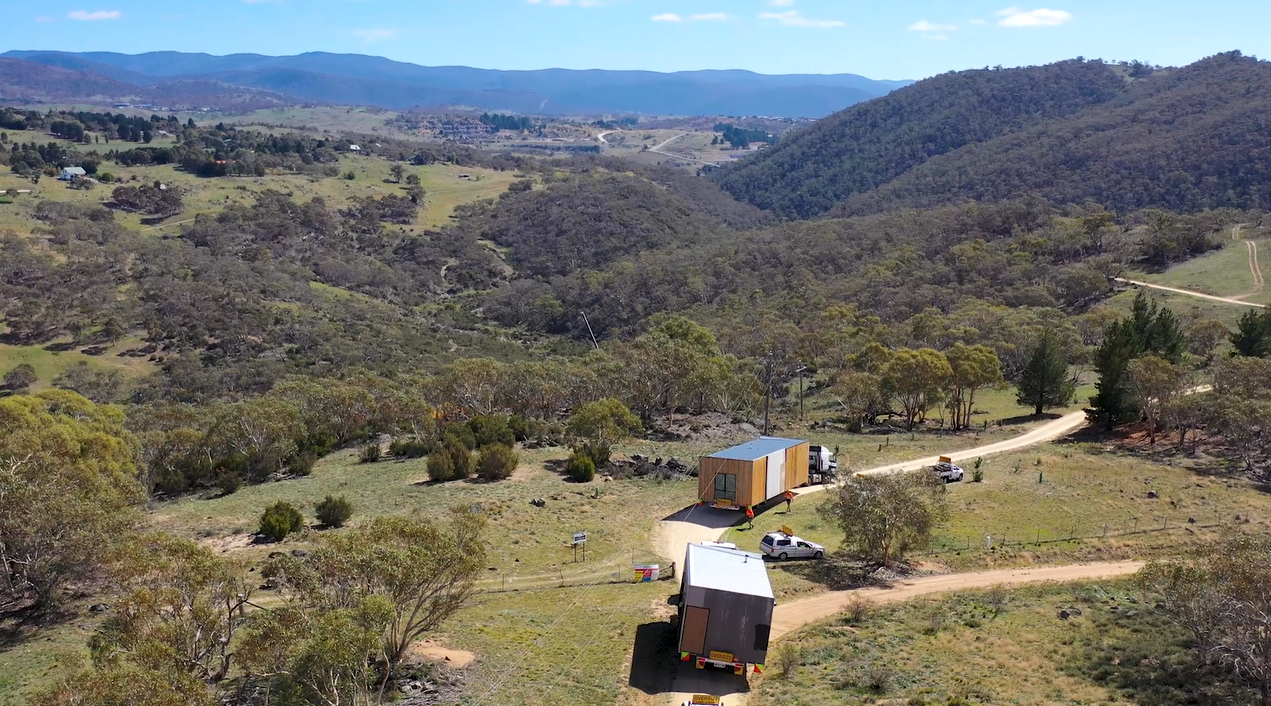
Image: A defining moment on site at our Toora Project—modules lifted into place as the home begins to take shape in the landscape.
Timber today is not the timber of the past.
Advancements in engineered timber, digital design, and modern methods of construction are unlocking new possibilities in scale, performance and efficiency.
Designers can now model complex structures with precision. Builders can assemble components faster and with greater accuracy. Hybrid systems are emerging that combine the strengths of different materials while reducing overall impact.
At the same time, better data is enabling more transparent carbon accounting and lifecycle analysis. Tools like the WoodSolutions Carbon Calculator allow project teams to quantify the carbon benefits of timber and communicate them clearly.
This combination of innovation and evidence is accelerating adoption — not just in Australia, but globally.
At Ecoliv, we talk about regeneration, not just sustainability.
Sustainability asks how we reduce harm. Regeneration asks how we create positive impact.
Timber has a unique role to play in that future.
When sourced from responsibly managed forests, it supports a cycle of growth, harvest and regrowth. It stores carbon in buildings while new trees continue absorbing CO₂. It enables construction systems that are lighter, more efficient and less wasteful.
A regenerative timber future for Australia would mean:
This is not a distant vision. It is already beginning to take shape.
Timber is not a compromise.
It is a high-performance, future-ready material that allows us to build better — for people, for place, and for the planet.
At Ecoliv, we see timber as central to the next evolution of housing in Australia. Not just because it reduces carbon, but because it enables a more thoughtful, more regenerative way of building.
The future of construction is not heavier.
It’s lighter. Smarter. More connected.
And timber is leading the way.
Explore floorplans, pricing, specifications and the sustainable features that make an Ecoliv home regenerative by design.
Speak directly with our team to discuss your site, budget and vision — and discover what’s possible.
Experience the comfort, craftsmanship and performance of an Ecoliv home in person.
Open Mon-Fri 9am-5pm
1114 Bass Hwy, The Gurdies VIC 3984
Phone +61 (03) 5672 5196
Email info@ecoliv.com.au


